
Many businesses contract external firms to carry out recurring financial administration and reporting tasks. This practice involves assigning specific bookkeeping entries, payroll calculation and filings, accounts payable and receivable processing, bank reconciliations, and preparation of routine financial statements to third-party providers that operate separately from the company’s internal staff. The arrangement typically focuses on operational accuracy, consistent recordkeeping, and meeting statutory filing deadlines rather than on internal strategic decision-making.
Outsourcing in this context also frequently covers tax-related support such as organizing documents for tax preparers, preparing routine tax schedules, and maintaining records to support deductions and credits. Providers may handle compliance-related activities that intersect with federal and state regulations, such as wage withholding reporting and sales tax tracking. Scope often varies by provider and by the client’s size and complexity, with service packages tailored to include combinations of the core functions listed above.

Many U.S. small and medium-sized enterprises select a mix of these examples to match internal capacity and regulatory needs. For instance, a business may pair outsourced bookkeeping with a cloud accounting platform to maintain real-time ledgers while delegating payroll to a specialist payroll processor. Contract terms and service-level descriptions often specify deliverables such as frequency of reconciliations, timing for management reports, and data access protocols. Providers may use standardized statement formats that align with common U.S. accounting practices, which can simplify interaction with tax preparers and auditors.
When outsourcing payroll-related tasks in the United States, vendors commonly address federal and state withholding rules, unemployment insurance reporting, and Form 941 or state equivalents. Firms that handle payroll often integrate with timekeeping systems and benefits platforms to capture wages accurately. Compliance responsibilities can be shared: employers remain legally responsible for correct tax remittances, while vendors typically perform calculations and may file on the employer’s behalf if contractually agreed. Clarity in the service agreement about who files which forms is therefore frequently recommended as a practical consideration.
Accounts payable and receivable functions that are outsourced often include invoice capture, vendor communication, electronic payments, and collections follow-up. Automation through U.S.-focused platforms may reduce manual entry and shorten invoice-to-payment cycles, but implementations can require mapping of chart of accounts and approval workflows. Outsourced teams may also assist with implementing internal controls, such as segregation of duties between invoice approval and payment execution, which can help with audit readiness and fraud risk management in a U.S. regulatory context.
Record management and retention practices administered by external providers typically align with U.S. tax statute of limitations and archival needs for financial audits. Providers may store digital copies of source documents and reconciliations for the timeline suggested by the Internal Revenue Service, and they may offer retrieval processes for records during tax examinations. Data security and access controls are commonly documented in service agreements, and businesses often specify backup frequency, encryption standards, and incident response expectations as part of scope definition.
In summary, outsourcing routine accounting activities involves delegating clearly defined operational tasks—bookkeeping, payroll, AP/AR, reconciliations, reporting, and recordkeeping—to external providers under contractual terms that address responsibilities and compliance. Service combinations vary by business size and complexity, and typical arrangements may include integration with U.S. payroll processors and cloud accounting platforms. The next sections examine practical components and considerations in more detail.
Outsourced accounting arrangements commonly group services into functional types: transaction processing (bookkeeping), payroll services, accounts payable/accounts receivable management, reconciliations, and periodic financial reporting. In the United States, these categories often map to operational deliverables such as weekly payroll runs, monthly reconciliations against bank statements, and quarterly management reports. Businesses may select full-service arrangements that cover multiple functions or single-service engagements focused on a specific process. Typical engagement documents define frequency, deliverables, and escalation points for exceptions and discrepancies encountered during processing.
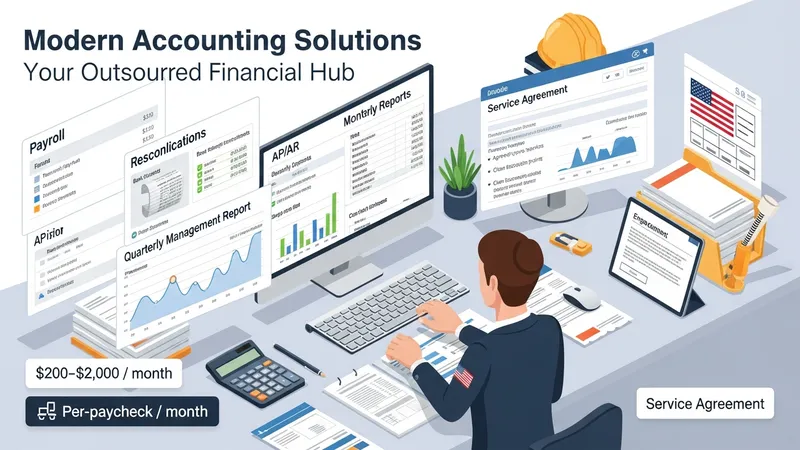
Pricing for these service types can vary widely in the U.S. market depending on transaction volume, complexity, and level of automation. For example, basic monthly bookkeeping packages for a small business may typically range from about $200 to $2,000 per month, while payroll processing fees may be charged per paycheck plus a base fee, often depending on the number of employees. These ranges are indicative and may change according to regional labor costs, integration requirements, or need for specialized industry reporting such as cost accounting for construction contractors.
Providers offering payroll services in the United States commonly address tax filing obligations at federal and state levels. Firms that manage payroll may reference Department of Labor guidance for wage and hour considerations and the Internal Revenue Service for federal tax deposits and returns. When evaluating functional coverage, businesses often consider whether the provider will file returns on their behalf, prepare year-end forms such as W-2s and 1099s, and support multi-state payroll requirements if employees work across states with different withholding rules.
Operationally, outsourced AP/AR services may include electronic invoicing, vendor onboarding, payment execution via ACH or check, and automated reminders for past-due receivables. In the U.S., providers may integrate with banking partners and use Automated Clearing House (ACH) networks for payments. Firms considering outsourcing these functions often plan for initial mapping of vendor and customer master files, establishment of approval hierarchies, and periodic review cycles to reconcile outstanding items and reduce aged payables or receivables balances.
Tax-related support provided by outsourced accounting firms in the United States often focuses on preparation of schedules, organization of tax-basis records, and timely provision of documentation to tax preparers. Providers may assemble information for federal returns, support state sales and use tax calculations, and prepare payroll tax filing summaries. It is common for outsourced teams to liaise with Certified Public Accountants (CPAs) or enrolled agents when specialized tax advice or representation is required, while clearly documenting which party is responsible for filing and remittance to avoid compliance gaps.
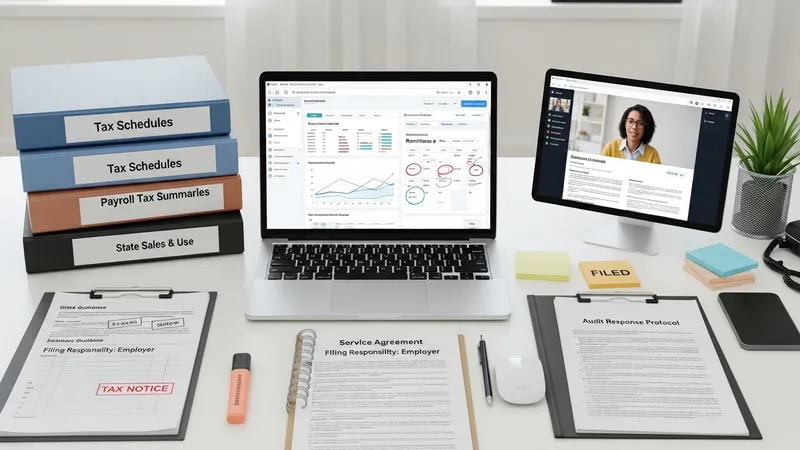
Regulatory compliance considerations in the U.S. also encompass wage and hour laws, payroll tax rules, and industry-specific reporting requirements. For payroll and employment tax matters, many providers reference guidance from the Internal Revenue Service (irs.gov) and the Department of Labor (dol.gov) when determining withholding and reporting practices. Businesses may specify frequency of tax remittance reporting, the handling of tax notices, and protocols for responding to audits in the service agreement, with the caveat that ultimate legal responsibility for correct filings typically remains with the employer.
Sales tax and use tax management in multi-state operations can be an area where outsourced accounting adds operational value. In the United States, state and local tax rules vary in scope and filing frequency; providers that support sales tax often maintain awareness of common nexus triggers and state registration processes. Outsourced teams can compile transaction-level details needed for returns and may coordinate with state portals for filings, although businesses commonly confirm who holds responsibility for remittance and any registrations required in each state.
Data retention and documentation relevant to tax examinations are often defined with reference to generally accepted practices and IRS guidelines. Providers may maintain digital archives of source documents and reconcilements for the timeframe businesses commonly retain tax records in the U.S. Contracts may include provisions on how long records are kept, access rights for the business, and procedures to retrieve documents for tax filings or audit requests. These terms are frequently negotiated to align with the company’s internal policies and external compliance needs.
Cloud accounting platforms and payment automation tools frequently form the technological backbone of outsourced accounting arrangements in the United States. Integrations with systems such as payroll processors, banking feeds, and expense management applications can streamline data flow and reduce manual entry. When providers use U.S.-focused software like QuickBooks Online or Bill.com, integration points are typically documented in onboarding plans and tested prior to live processing to ensure consistent mapping of accounts and proper handling of vendor and customer records.
Data security and privacy are commonly addressed through contractual clauses and technical controls. In U.S. engagements, providers often reference encryption, secure file transfer protocols, role-based access controls, and periodic backups as components of their security posture. Businesses may request evidence of security practices, such as SOC 1 or SOC 2 reports, to assess internal control frameworks, while remaining mindful that such reports describe controls rather than offering absolute assurances about risk elimination.
Implementation of automation may require an initial data cleanup to align the client’s chart of accounts, vendor/customer records, and historical transactions with the provider’s processing templates. Common onboarding activities in the United States include account reconciliations for opening balances, setup of recurring transactions, and configuration of approval workflows. These preparatory steps often determine the speed at which a provider can deliver accurate monthly close activities and may influence initial fee structures or project timelines.
Interoperability with banks and payroll systems in the U.S. may involve verifying ACH authorization, connecting to bank feeds, and establishing electronic payment templates. Providers typically document required client responsibilities for authorizations and may outline timelines for transaction clearing and settlement. As a consideration, firms often clarify how exceptions—such as returned payments or account reconciliation discrepancies—will be tracked and communicated to the client to support timely resolution without suggesting prescriptive action.
Clear governance and contract terms commonly form the foundation of successful outsourced accounting relationships in the United States. Contracts often specify scope of services, frequencies for deliverables (for example monthly reconciliations and quarterly reviews), fee structures, onboarding activities, and termination procedures. Businesses may include provisions addressing data access, intellectual property of financial processes, confidentiality, and liability limitations. These contractual elements are typically framed to align with U.S. commercial law and industry-standard practices for professional services.

Performance monitoring metrics frequently used in the U.S. context include timeliness of month-end close, bank reconciliation completion rates, invoice processing cycle times, and accuracy of payroll calculations. Service-level agreements (SLAs) may define acceptable thresholds for these metrics and describe reporting cadence for performance reviews. Periodic review meetings commonly provide a forum for discussing trends, addressing recurring exceptions, and aligning on process improvements while recognizing that metric targets tend to be aspirational and should be interpreted with operational nuance.
Risk management considerations often focus on internal control design, segregation of duties, and contingency plans for business continuity. In U.S.-based engagements, businesses may require providers to maintain disaster recovery plans and to document how staff access is provisioned and revoked. Periodic assessments of control effectiveness—sometimes conducted by internal audit or an independent reviewer—may be requested to validate that outsourced processes support accurate financial reporting and reduce exposure to fraud or operational disruption.
Ongoing relationship management typically involves scheduled check-ins, periodic reconciliations of service scopes, and updates to reflect regulatory changes such as new payroll filing requirements or state-level tax law adjustments. In the United States, staying current with federal and state guidance is a shared consideration; providers may notify clients of potential compliance impacts, while clients commonly retain ultimate responsibility for strategic tax positions and statutory filings. These arrangements are often designed to balance operational efficiency with clear accountability.