
Voice-based artificial intelligence for customer support refers to software systems that process spoken language to assist or automate interactions between customers and service organizations. These systems typically combine automatic speech recognition (ASR) to convert audio to text, natural language understanding (NLU) to interpret intent, dialogue management to decide next steps, and text-to-speech (TTS) to produce spoken responses. In United States operational contexts, voice AI is often integrated with contact center infrastructure to handle routine queries, provide self-service, or assist human agents by surfacing relevant information during live calls.
Implementation approaches vary by use case and scale. Some contact centers use cloud-hosted voice AI modules from major providers, while others deploy on-premises components for integration with legacy telephony. Common use cases in the United States include automated call routing, interactive voice response (IVR) systems that accept natural speech, virtual agents that handle inquiries, and agent-assist tools that offer real-time transcription and suggested replies. Each approach typically balances accuracy, latency, privacy controls, and integration complexity.
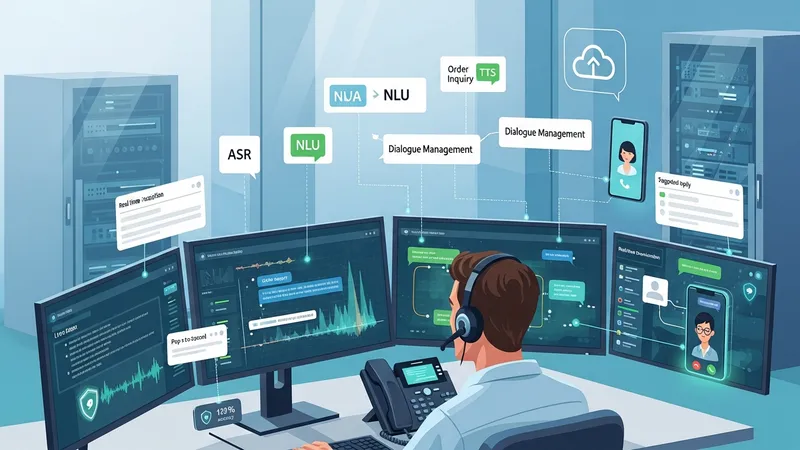
Speech recognition and language understanding are foundational technical elements. ASR systems convert audio captured from telephone or VoIP channels into text, and their performance can vary with speaker accent, background noise, and audio codec used by US telephony networks. NLU models then map transcribed text to intents or slots that represent user goals or entities. Developers often measure performance with metrics such as word error rate (WER) for ASR and intent classification accuracy for NLU, noting that performance observed in controlled tests may differ from live call environments and typically requires ongoing tuning.
Virtual assistants and IVR systems may be configured for different levels of autonomy. In many US deployments, voice agents handle routine requests like account balance checks, scheduling confirmations, or status inquiries, while escalation strategies keep a human agent available for complex or sensitive matters. Call routing logic often integrates voice AI outputs with contact center routing rules so that recognized intents can trigger transfers to subject-matter specialists. Organizations typically monitor fallback rates and escalation frequency to refine decision thresholds.
Multilingual support and accessibility are common operational considerations in the United States. Voice AI solutions may include models trained on multiple languages or dialects and use language detection to route callers appropriately. Accessibility features such as real-time captioning or support for assistive communication methods can help organizations comply with accessibility expectations or regulations. Language model selection and testing in representative US demographics are often necessary to reduce bias and improve coverage for diverse caller populations.
Analytics and integration determine how voice AI contributes to broader customer service workflows. Captured transcripts, intent distributions, and call metadata can feed dashboards, workforce management, and quality-assurance processes. Integrations with CRM systems, ticketing platforms, and workforce optimization tools allow agents to see prior bot interactions and reduce repeat information requests. Data governance and privacy considerations are commonly factored into design decisions, especially where voice recordings may contain personally identifiable information (PII).
When evaluating voice AI support, organizations often consider trade-offs between on-premises and cloud-hosted components, expected call volumes, and compliance obligations under US regulations. Pilot deployments and incremental rollouts are commonly used to validate real-world performance and user experience before broader adoption. The next sections examine practical components and considerations in more detail.
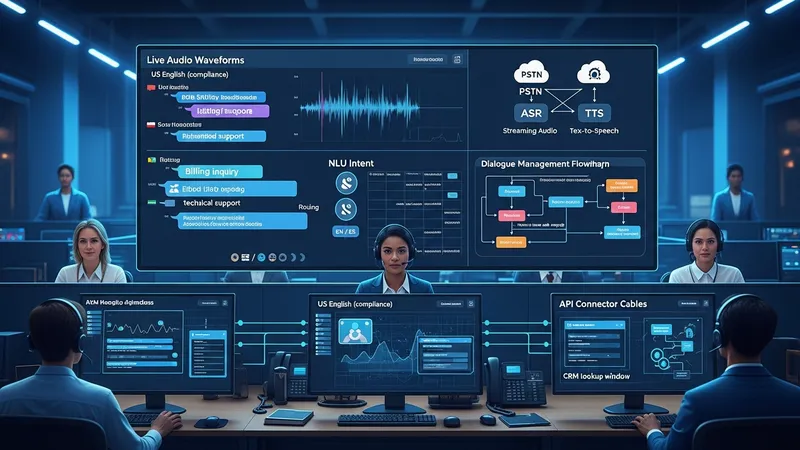
Voice AI support commonly comprises several interoperable components: automatic speech recognition (ASR), natural language understanding (NLU), dialogue management, text-to-speech (TTS), and integration adapters for telephony and back-end systems. In United States contact centers, ASR and TTS are frequently provided by cloud services that can accept PSTN or SIP audio streams. Dialogue managers may be rule-based or driven by statistical or neural policies that determine how the system responds. Integration adapters map intents and entities from the conversational layer into actions such as CRM lookups, ticket creation, or agent transfers.
Component selection often depends on specific functional requirements. For example, an organization that needs strong transcription for compliance review may prioritize ASR providers with established performance on US English; one that needs multilingual routing may seek platforms with robust language detection for Spanish and other languages common among US callers. Many US implementations mix vendor services—using one provider for ASR and another for dialogue management—so interoperability and API compatibility are key practical considerations.
Telephony interface and call routing elements are essential parts of voice AI deployments in the United States. Interactive voice response (IVR) platforms that accept speech input are often adapted to route calls based on predicted intent. Call routing rules may incorporate predictive analytics such as estimated handle time or agent skill matching. Considerations such as latency introduced by cloud round trips and the ability to operate during network outages inform whether organizations choose hybrid architectures combining cloud and local routing logic.
Voice AI components also intersect with quality-control systems used in US contact centers. Transcripts produced by ASR can be used to populate speech analytics tools that detect trends or compliance issues. Test data sets that reflect the diversity of US callers—regional accents, background noise typical of mobile calls, and domain-specific terminology—are commonly used to benchmark component performance before wide deployment. These evaluations typically guide iterative improvements rather than serving as one-time certification.
Performance for voice AI in US customer service settings is typically measured across dimensions such as ASR word error rate, intent recognition accuracy, latency, and conversational success rate. Real-world accuracy may decline relative to lab conditions due to ambient noise, mobile network audio compression, and speaker variability. United States contact centers often run shadow deployments or A/B experiments to compare vendor models on representative call samples. Outcomes from these tests can inform model tuning, vocabulary expansion, and the addition of domain-specific language models to improve recognition of industry terms.

Latency and system responsiveness can affect caller experience and agent workflows. In telephony contexts common in the United States, round-trip delays from audio capture to AI response and back to caller may be influenced by network hops and cloud region placement. Teams frequently monitor end-to-end latency and set thresholds for when to route calls directly to agents. Considerations include codec compatibility with US carriers, jitter buffering settings, and whether partial recognition results can be streamed to agents to reduce perceived wait times.
Evaluation frameworks often combine automated metrics with human-in-the-loop review. Quality-assurance specialists in the United States may sample transcripts to assess intent mapping fidelity and conversational tone. Error categories such as misrecognitions, incorrect intent assignments, and inappropriate system prompts are tracked to prioritize model improvements. Iterative model retraining using anonymized, consented US call data is a common practice to reduce systematic errors while maintaining privacy safeguards.
Privacy and compliance considerations also affect performance choices. For calls originating or processed in the United States, organizations may apply data retention policies and redaction of sensitive information in transcripts to align with internal governance and regulatory expectations. These constraints can influence the amount and type of training data available for continuous improvement, so teams often establish data-handling procedures and audit trails as part of performance management. Continued monitoring and conservative adjustments help maintain acceptable performance levels over time.
Call routing enhanced by voice AI can shift how work is distributed in US contact centers. Intent classification can be used to pre-route calls to specialized teams or to present agents with context derived from the caller’s initial interaction. When virtual assistants handle routine interactions, supervisors often observe changes in contact volume patterns and may adjust staffing models. Organizations in the United States may track metrics such as containment rate (percentage of interactions resolved by automation) and transfer rate to understand operational effects and to recalibrate routing thresholds.
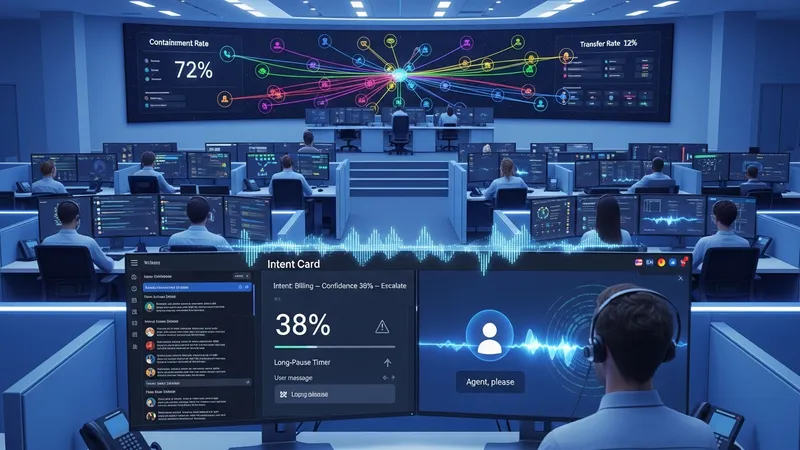
Virtual assistants intended for the US market are frequently designed with escalation strategies to hand calls to human agents for complex or sensitive issues. These strategies commonly combine signals such as repeated failed intent recognition, long pauses, or explicit user requests for an agent. From an operational perspective, teams consider the visibility of bot interactions in agent desktops so human agents can see prior steps taken by the assistant, minimizing redundant questioning and improving average handling time in an integrated workflow.
Multilingual support is a practical requirement for many US service organizations. Commonly, deployments include US English and Spanish models, and may add additional languages according to customer demographics. Language identification, regional dialect handling, and culturally appropriate phrasing are areas of focus. Organizations often pilot language-specific models and measure separate accuracy metrics per language to ensure equitable performance and to identify where targeted data collection or model adaptation is needed.
Accessibility and regulatory considerations intersect with routing and virtual assistant design. In the United States, accessibility expectations may lead to offering alternative channels or real-time captioning for callers who are deaf or hard of hearing. From an operational standpoint, these features may require additional integrations and monitoring. Teams commonly document fallback policies and agent responsibilities to handle cases where automated assistants cannot provide an adequate experience, ensuring consistent service across channels.
Analytics derived from voice AI systems can inform quality assurance, training, and product feedback loops in US organizations. Common analytics outputs include intent frequency, average handling time, sentiment trends, and topics that lead to escalation. These outputs are often forwarded to workforce management and business intelligence platforms to align staffing with demand and to surface recurring issues. When integrating analytics, teams typically normalize data formats to combine bot interactions and agent-handled call records for comprehensive reporting.

System integration is a central deployment consideration. Voice AI modules are typically integrated with CRM systems such as Salesforce or ticketing platforms used by US service teams so that conversational context is available to agents. Middleware or connector layers often translate bot intents into CRM actions or populate case fields automatically. Deployment teams commonly evaluate API rate limits, event delivery guarantees, and retry strategies to maintain consistent integration behavior under load.
Security, data governance, and compliance influence deployment choices in the United States. Controls such as access logging, encryption of audio at rest and in transit, and role-based access to transcripts are commonly implemented. Deployment architectures may be selected to meet data residency or contractual requirements; for example, using cloud regions that comply with an organization’s data handling policies. Privacy impact assessments and vendor due diligence are typical preparatory steps before production rollout.
Operationalizing voice AI often follows an iterative deployment path that begins with limited pilots and expands based on measured outcomes. Insider considerations include maintaining a representative test corpus of US caller audio for regression testing, establishing procedures for human review of flagged interactions, and scheduling regular model evaluation cycles. These practices help maintain alignment between conversational models and evolving customer expectations while managing technical and organizational risks.