
The concept described here concerns a software platform's inventory-management capabilities specifically designed to support small and mid-sized manufacturers. This concept includes digital tracking of raw materials, assemblies, and finished goods; controls for stock levels; mechanisms to assign inventory to production orders; and interfaces for warehouse operations. In practice, such a system may centralize item records, unit measures, and location data so manufacturing teams can view availability and movement without relying solely on spreadsheets or manual logs.
Within a manufacturing environment, inventory capabilities typically tie stock data to production workflows and purchasing processes. Features often include bill of materials (BOM) linkage, lot and serial tracking, and automated alerts for low stock that may inform purchase order suggestions. For manufacturers operating in the United States, these functions may be integrated with U.S.-focused accounting packages and shipping carriers to align inventory records with financial posting and distribution steps.
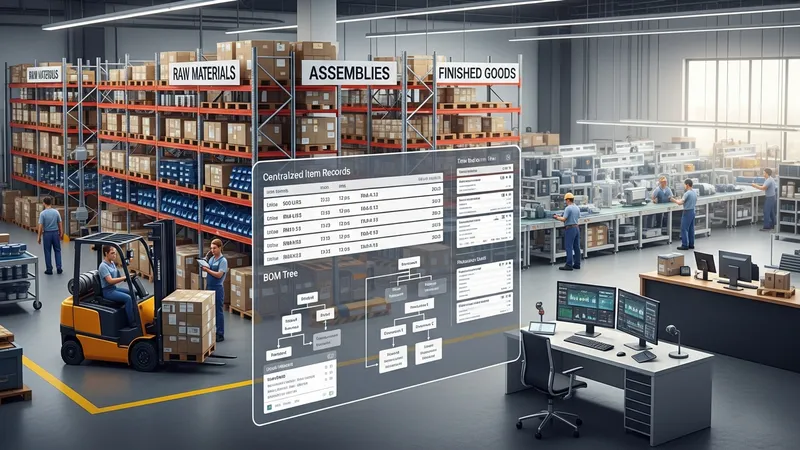
Selection criteria for these examples emphasized components commonly used by U.S. manufacturers: a manufacturing-focused inventory module that links to production, barcode hardware for warehouse capture, and accounting integration for financial alignment. The list is representative rather than exhaustive and is intended to illustrate the types of tools and integrations that commonly appear in U.S. manufacturing inventory setups. Pricing indications are typical ranges or descriptions and do not reflect guarantees or specific vendor quotes.
An informational expansion on stock tracking explains how location-aware records and transactions can reduce count discrepancies. Inventory systems may support multiple warehouse locations, bin-level storage, and cycle-count procedures. In the United States, manufacturers often track inventory turnover and days of inventory on hand as operational KPIs; these metrics can be calculated from system transaction histories and exported for analysis. Traceability features such as lot and serial number capture typically allow manufacturers to locate units across production and shipping stages.
Inventory control within manufacturing workflows often involves automated reordering logic and safety stock configuration. Reorder points may be set per item or per location and can be influenced by lead times recorded on supplier records. For U.S. manufacturers, purchase order workflows may be routed to purchasing staff and then synchronized with accounting systems. Systems may also support demand-based suggested orders generated from planned production requirements linked to BOMs and sales orders.
Warehouse management features commonly present include picking lists, putaway rules, and integration with barcode scanning. These capabilities can reduce manual entry and improve picking accuracy, which is often relevant for U.S. distributors and manufacturers who ship to multiple carriers. Warehouse layout logic and prioritized picking strategies may be configurable so that frequently moved items are placed for efficient access. Data from scanning activities typically updates both stock-on-hand and transaction timestamps for audit trails.
Reporting and analytics components typically provide inventory valuation methods, transaction histories, and dashboards for KPIs. In a U.S. manufacturing context, reports may be used to reconcile inventory with accounting records and to prepare for audits. Common report types include slow-moving items, stock aging, BOM consumption, and production variance. Export formats often include CSV and PDF to integrate with other U.S. business systems or for regulatory recordkeeping where applicable. The next sections examine practical components and considerations in more detail.
Stock tracking features in a manufacturing inventory module may include per-item unit measures, multiple location balances, and transaction histories that record receipts, issues, adjustments, and transfers. Functions often permit assignment of stock to specific production orders so that allocated quantities are reserved and reflected in available balances. Within the United States, manufacturers often align item records with part numbers and supplier catalog identifiers, which can simplify purchase ordering and vendor communication. Systems may offer FIFO or weighted-average valuation methods to support internal accounting practices, though choice of method typically depends on company policy and U.S. accounting guidance.
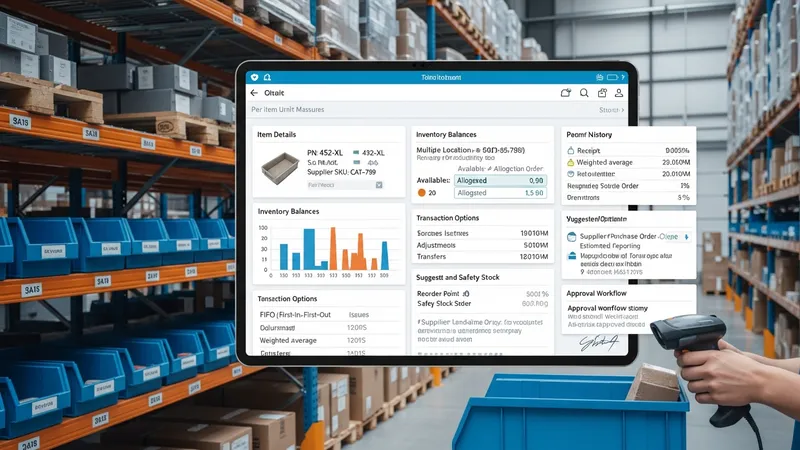
Control mechanisms commonly include reorder points, safety stock parameters, and suggested purchase order generation based on planned production requirements. Reorder logic may consider supplier lead times stored in vendor records and recent demand patterns. For U.S. manufacturers working with domestic and international suppliers, lead-time variability can influence reorder buffer sizing. Systems may also include approval workflows for stock adjustments that create an audit trail, which can be relevant for internal controls and external reviews.
Lot and serial tracking capabilities may be provided to support traceability across manufacturing and distribution stages. Lot-level tracking can record production and receipt batches, enabling recall response or targeted investigations when quality issues arise. Serial tracking is often applied to serialized finished goods and may integrate with shipping documentation. In regulated U.S. sectors—such as medical device or aerospace—traceability features can assist with compliance-oriented recordkeeping, though specific regulatory obligations remain the manufacturer’s responsibility.
Cycle counting and physical inventory procedures can be facilitated through scheduled count plans and exception reporting. Cycle counts that target high-value or high-velocity SKUs may reduce disruption compared with full shutdown counts. Barcode or RFID scanning often supports these processes by reducing manual transcription errors. When cycle counts reveal discrepancies, integrated adjustment workflows can document the rationale and maintain transaction-level history suitable for reconciliation with accounting records.
Warehouse management features geared to manufacturing may cover location hierarchies, bin management, and putaway rules informed by item attributes. Systems can map physical storage zones and define preferred receiving and picking locations. In U.S. operations, manufacturers may integrate warehouse activities with parcel and freight carriers—such as UPS or FedEx—to streamline outbound logistics; this integration typically exchanges shipment metadata and tracking numbers rather than replacing carrier processes. Warehouse task lists and picking tickets produced by the system may be organized by production priority or shipping schedules.

Barcode scanning integration often connects warehouse tasks with inventory transactions, updating item balances and timestamps in near real time. Common U.S. hardware vendors include manufacturers of rugged handheld scanners and mobile computers; these devices may be configured to scan item barcodes, lot/serial labels, and location barcodes to reduce mis-picks. Scanning workflows typically validate item-location pairs during putaway and picking to reduce errors and to record operator actions for traceability.
Order handling for manufacturers usually distinguishes between sales order fulfillment and production order issuance. Sales orders may reserve finished goods for shipping, while production orders allocate raw materials for consumption. Systems may support partial shipping and backorder management so that available inventory can be dispatched while remaining quantities are scheduled for later production. Integration with accounting systems used in the United States can ensure that order invoicing and revenue recognition follow the company’s financial policies.
Interfacing warehouse data with external systems often relies on export formats such as CSV or API-based exchanges. API integration may allow real-time queries of inventory availability for e-commerce storefronts or distributor portals commonly used by U.S. manufacturers. When designing integrations, companies typically consider data ownership, synchronization frequency, and error-handling procedures to maintain consistent records across warehouse, production, and sales systems.
Material planning in manufacturing inventory systems typically starts from the bill of materials and a master production schedule. Planning functions can explode BOMs to determine component requirements and may create suggested purchase orders or production work orders based on demand. For U.S. manufacturers, planning tools may need to account for domestic lead times, supplier minimum order quantities, and transit times, which can affect safety stock calculations and order timing. Planning outputs often include component shortage lists and planned receipts to inform procurement activity.
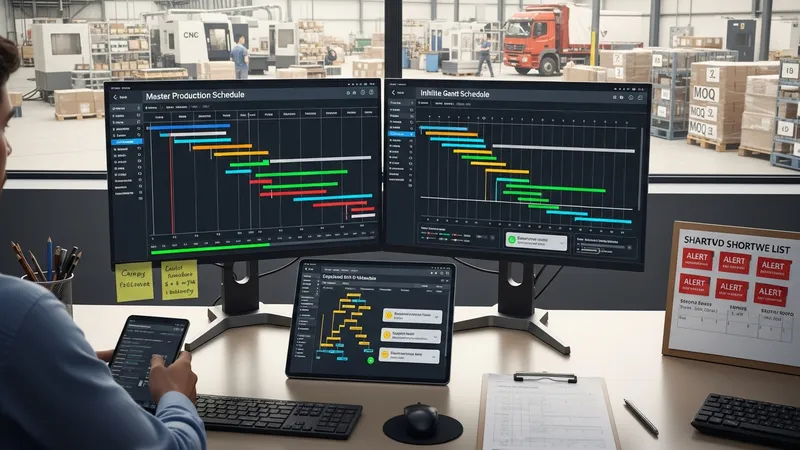
Production scheduling features may provide finite or infinite scheduling views to help planners sequence work on available capacity. Finite scheduling allocates operations against actual machine or labor capacity, which can help identify bottlenecks and realistic completion dates. Infinite scheduling typically shows an unconstrained view of planned start and finish dates based on demand; planners often use this as a baseline before applying capacity constraints. Scheduling data commonly integrates with shop-floor reporting tools that record actual start/stop times and operation completions.
Routing and operation definitions in the inventory-production linkage describe the sequence of steps and resource requirements for manufactured items. These definitions inform material issuing and labor allocation when a production order is released. In U.S. small manufacturing environments, digital routing can replace paper traveler packages and reduce transcription errors; it also allows for capture of operation-level yields and scrap, which can feed into variance analysis and continuous improvement efforts.
Lead time management and supplier performance tracking are typically part of material planning considerations. Recording supplier lead-time variability and on-time delivery metrics may help planners set more accurate reorder points. U.S. manufacturers often track supplier metrics and may use reported delivery performance to adjust planning buffers. Systems that allow users to tag alternate suppliers or specify expedited procurement options may support responsiveness when supply disruptions occur.
Reporting tools in an inventory-focused manufacturing system generally include standard reports for stock valuation, consumption, production yields, and discrepancy analysis. For U.S. manufacturers, aligning inventory reporting with accounting requirements and internal controls is common practice. Reports may support reconciliation with general ledger balances and provide documentation for external audits. Exportable transaction histories and audit trails often assist finance teams in verifying inventory adjustments and production consumption events recorded over a fiscal period.
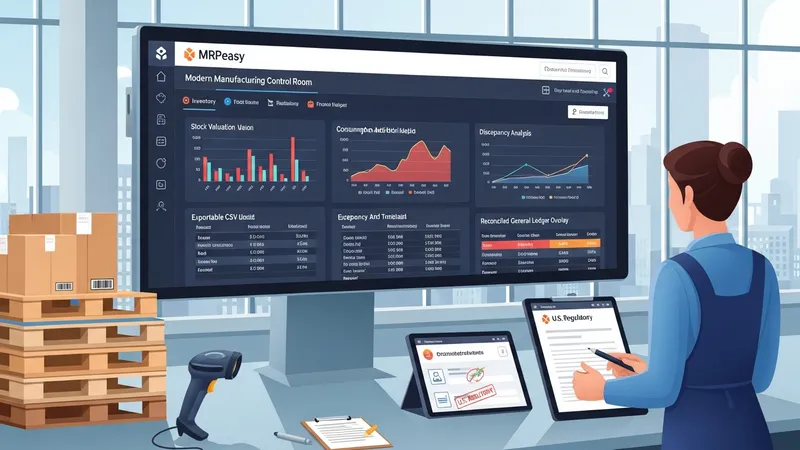
Traceability and compliance considerations often shape how lot and serial data are captured and retained. Certain U.S. regulatory frameworks and industry standards require manufacturers to maintain traceability records for specific product types; inventory systems that record lot/serial movement and link them to production and shipping events can assist with fulfilling such obligations. It is prudent to treat system features as tools that can support compliance processes while recognizing that regulatory responsibilities remain with the manufacturer.
Operational performance reporting commonly monitors KPIs such as inventory turnover, on-time fulfillment, and production lead-time variance. U.S. manufacturers may benchmark these metrics against industry reports published by trade associations or government sources such as the U.S. Census Bureau. Dashboards that present real-time or near-real-time indicators can help operations and management teams identify trends, investigate root causes, and prioritize process adjustments without implying guaranteed outcomes.
Practical considerations when evaluating inventory functionality include data migration effort, user training, and integration testing with U.S.-centric partners such as accounting platforms and carriers. Attention to master data quality—consistent naming, unit measures, and supplier records—may reduce implementation friction. Additionally, testing scenarios that simulate end-of-period inventory counts, returns, and production scrap can reveal configuration refinements before full production use. Continued monitoring and periodic process reviews may help sustain accurate inventory records over time.