
Voice AI support refers to the use of automated conversational systems that process spoken language to assist with customer service interactions. These systems combine speech recognition, natural language understanding, dialogue management, and text-to-speech to interpret caller intent, generate responses, and route or escalate contacts. In Australian contact-centre environments, voice AI often operates alongside human agents to handle routine enquiries, provide status updates, authenticate callers, or capture interaction metadata for downstream processing. The technology typically aims to improve handling capacity and consistency while maintaining compliance with local communications and privacy expectations.
Technically, voice AI support systems may use on-premises or cloud-hosted components that are tuned to regional accents, regulatory requirements, and integration targets such as CRM or billing systems. Common modules include automatic speech recognition (ASR), natural language processing (NLP), dialogue orchestration, and analytics. In Australia these modules are frequently adapted to account for Australian English varieties and multilingual service needs. Deployment choices often reflect data residency preferences, vendor availability in Australia, and existing telephony infrastructure used by service providers and enterprises.

When comparing implementations, Australian organisations may consider whether voice models are trained on locally relevant speech data and whether vendors provide regional hosting. Performance metrics such as word error rate and intent detection accuracy can vary with accent diversity and background noise typical of phone channels. Integration pathways often influence design: some teams prioritise tight CRM integration for context-aware dialogues, while others focus on lightweight IVR replacements. Selection criteria typically include model adaptability, deployment locations (data residency), integration interfaces, and compliance with local privacy guidelines.
Voice AI support can enable different interaction patterns in Australian customer service settings. For straightforward transactional calls, automated flows may complete authentication and status queries, reducing routine workload. For more complex issues, systems often provide assisted routing — capturing structured data before handing a caller to a human agent. Multilingual support is relevant in Australia’s diverse population; systems may incorporate language selection or fallback to agent transfer. Each pattern may require separate voice models, confidence thresholds, and escalation rules to maintain contact quality and legal compliance.
Operationally, successful voice AI deployments in Australia may rely on iterative testing with local voice samples and real-call scenarios. Accuracy can typically improve when models are fine-tuned to Australian English variants, common local place names, and industry-specific terminology. Logging and analytics components often provide interaction transcripts, sentiment indicators, and call-routing statistics that feed workforce planning. Organisations may also set phased rollouts—starting with limited-intent flows, monitoring performance, and expanding scope as systems reach acceptable accuracy and integration stability.
Challenges and governance considerations often centre on privacy, data retention, and transparency about automated handling. Under Australian privacy expectations, organisations frequently disclose recording and AI use, and they may configure retention and access controls to meet organisational policies and regulatory guidance. Security of telephony interfaces and access to transcripts are operational concerns that can influence architecture choices such as on-premises versus cloud hosting. Monitoring for bias, accuracy drift, and accessibility are ongoing operational tasks rather than one-time items.
In summary, voice AI support describes a set of technologies and practices that may augment customer service interactions in Australia by automating routine tasks, enabling multilingual handling, and producing analytics for continuous improvement. Implementations often balance model tuning for Australian speech patterns, integration with local systems, and adherence to privacy guidance from authorities such as the Office of the Australian Information Commissioner. The next sections examine practical components and considerations in more detail.

Voice AI solutions in Australia typically fall into several categories: automated IVR replacements, virtual conversational agents, speech analytics, and agent-assist tools. IVR replacements use ASR and finite-state dialogue to guide simple transactions; virtual conversational agents use intent recognition and dialogue management for more flexible exchanges; speech analytics retrospectively transcribe calls for quality and compliance; agent-assist tools surface suggested responses and summaries to human operators. Australian organisations often select one or more types depending on contact volumes, service complexity, and existing telephony platforms provided by carriers like Telstra or service providers offering local cloud regions.
IVR replacements may be deployed to handle routine account lookups, delivery status queries, or simple authentication flows. Virtual agents can address more varied enquiries by combining intent classifiers and slot-filling to collect required information. Speech analytics is commonly used in Australian contact centres to extract compliance-relevant phrases, measure silence and talk time, or detect sentiment trends over time. Agent-assist integrations often connect to CRMs such as Salesforce Australia, enabling context-aware prompts during live calls and reducing average handle time in measured deployments.
Selection between these types may be influenced by data residency considerations and telephony architecture. Cloud-hosted services with Australian regions may be preferred when local data storage aligns with privacy practices. Smaller organisations sometimes adopt hybrid approaches where ASR runs in the cloud while sensitive transcript storage is kept on-premises. Vendors such as Microsoft Azure, AWS, and local carriers support regional options; organisation-specific considerations often determine which category or combination of voice AI types is appropriate for phased rollout.
Operational considerations include expected call volumes, available integration effort, and staff training for handover scenarios. Pilot projects in Australia commonly focus on a narrow set of intents to establish baselines for accuracy and customer satisfaction before scaling. Performance measurement typically uses call-level metrics and qualitative reviews; iterative refinement often reduces misunderstanding rates. For organisations considering deployment, these types provide modular pathways to automate tasks while maintaining pathways for human escalation where necessary.

Speech recognition and NLP components used in Australia must account for regional accents, colloquialisms, and multilingual demand. Australian English presents phonetic patterns and local vocabulary (place names, slang) that can affect word error rates if models are trained on non-local corpora. Additionally, service providers in Australia may need to support languages commonly spoken by customers, such as Mandarin, Arabic, Vietnamese, and others. Models tuned with local voice samples and domain-specific lexicons typically perform better; organisations often arrange controlled data collection or vendor-led adaptation to improve recognition on real traffic.
Model evaluation in Australia may involve hold-out test sets drawn from local call recordings to measure intent detection accuracy and ASR error rates under realistic conditions. Background noise from call channels, mobile connections, and customer environment can influence recognition outcomes; robust front-end processing like noise reduction and voice activity detection is often applied. Careful selection of confidence thresholds and fallback strategies (repeat, clarification, transfer to agent) typically helps maintain interaction quality when recognition confidence is low.
For multilingual support, conversational systems often provide language detection or explicit language selection in initial prompts. Transliteration and mixed-language speech are operational challenges in some Australian contexts; systems may need to detect code-switching or provide direct agent handover when language coverage is insufficient. Licensing and vendor support for local language models differ across providers, so Australian organisations commonly verify vendor language coverage and the process for adding new language models before deployment.
Privacy and consent considerations intersect with speech processing choices. Organisations operating in Australia commonly notify callers that speech may be recorded and processed and document how transcripts are stored and accessed, in line with guidance from the Office of the Australian Information Commissioner. Anonymisation or minimisation strategies for transcript data are often applied to reduce exposure of personal information during model training or analytics. These measures can be part of procurement and deployment planning.
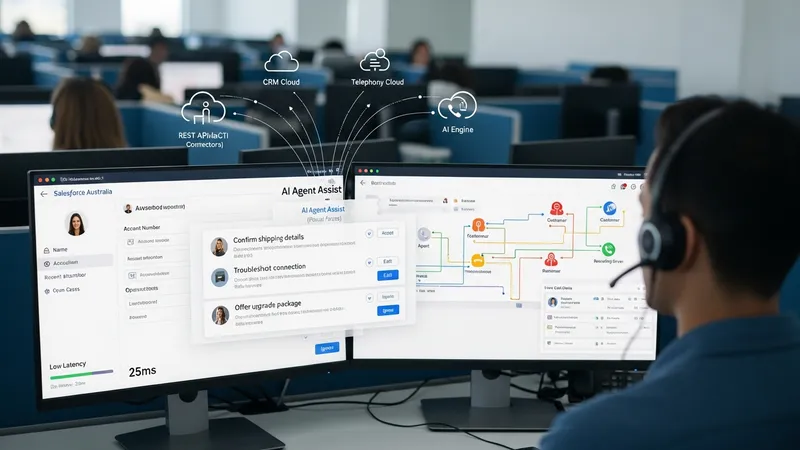
Integrating voice AI with existing Australian service workflows typically involves CRM connection, telephony bridging, and analytics pipelines. Common integration patterns include REST APIs, webhook-based eventing, and CTI connectors for platforms such as Salesforce Australia or local contact-centre systems. Analytics components generate transcripts, intent logs, and KPI dashboards that feed workforce management systems to inform staffing and queue management. Organisations often pilot integrations on limited queues to validate data flows and to ensure transcripts align with downstream reporting and quality frameworks used by Australian contact-centre teams.
Workforce interaction models vary: some Australian contact centres adopt blended approaches where agents handle complex calls and AI handles routine contacts; others implement agent-assist tools that provide real-time prompts and suggested responses. Real-time assistance requires low-latency pipelines and clear HMI design so agents can accept, edit, or ignore suggested content. Training and change-management are typically part of deployments, with staff briefings on how automated transcripts and suggestions are produced and how to correct AI outputs in live interactions.
Analytics often drive continuous improvement of voice AI in Australian operations. Monitoring common failure modes and retraining models with newly annotated calls can reduce misunderstanding rates over time. Quality assurance practices may include periodic human review of automated transcripts, spot checks for compliance phrases required by Australian regulators, and measurement of customer experience indicators such as post-call survey responses. These practices typically support incremental accuracy improvements and help maintain alignment with business objectives.
Operational scaling considerations include telephony throughput, model inference capacity, and storage for recorded interactions. Australian deployments commonly assess peak call volumes, regional redundancy, and disaster recovery for continuity. Organisations may choose local cloud regions to meet latency and data residency needs, or adopt hybrid architectures where telephony remains local while AI inference occurs in cloud regions that meet regulatory and performance criteria. These considerations feed into procurement and capacity planning processes.
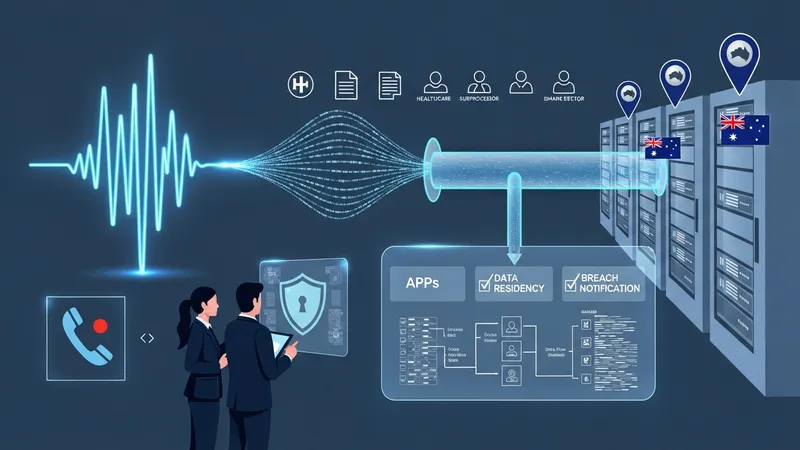
Regulatory and privacy frameworks in Australia shape how voice AI is designed and deployed. The Office of the Australian Information Commissioner publishes guidance on handling personal information, including recorded conversations, and Australian organisations commonly align retention and access policies with the Australian Privacy Principles (APPs). Telecommunications and consumer protection rules administered by the Australian Communications and Media Authority may also affect notification and disclosure practices for recorded or automated calls. Organisations typically document data flows and controls to demonstrate alignment with these frameworks.
Data residency and security are common considerations; some Australian organisations prefer local hosting or encryption controls that ensure transcripts and call recordings are stored under Australian jurisdiction. Vendor contracts often specify data handling practices, subprocessors, and breach notification obligations. Entities in regulated sectors such as financial services or healthcare may impose additional controls and typically consult legal and compliance teams to map voice AI processing against sector-specific obligations in Australia.
Bias, transparency, and accessibility considerations are part of responsible deployment. Australian organisations often assess whether models perform fairly across accent groups and demographic segments, and they may document testing protocols and remediation steps. Accessibility obligations under Australian law suggest systems should provide alternatives for callers who cannot use voice channels, such as web chat or assisted agent routing. Transparency about the use of automated handling—clear disclosure at call start and options to speak to an agent—may be included in scripts and compliance materials.
Rolling out voice AI in Australia typically follows staged pilots, measurement, and refinement. Pilot phases often define a small set of intents, measure recognition and completion rates, and gather agent feedback for refinement. Contracts with vendors usually include provisions for ongoing support, model updates, and local technical points of contact. Careful planning of retention, security, and compliance measures commonly helps organisations manage operational risk while exploring the potential efficiencies and service improvements voice AI may enable in Australian customer support contexts.